

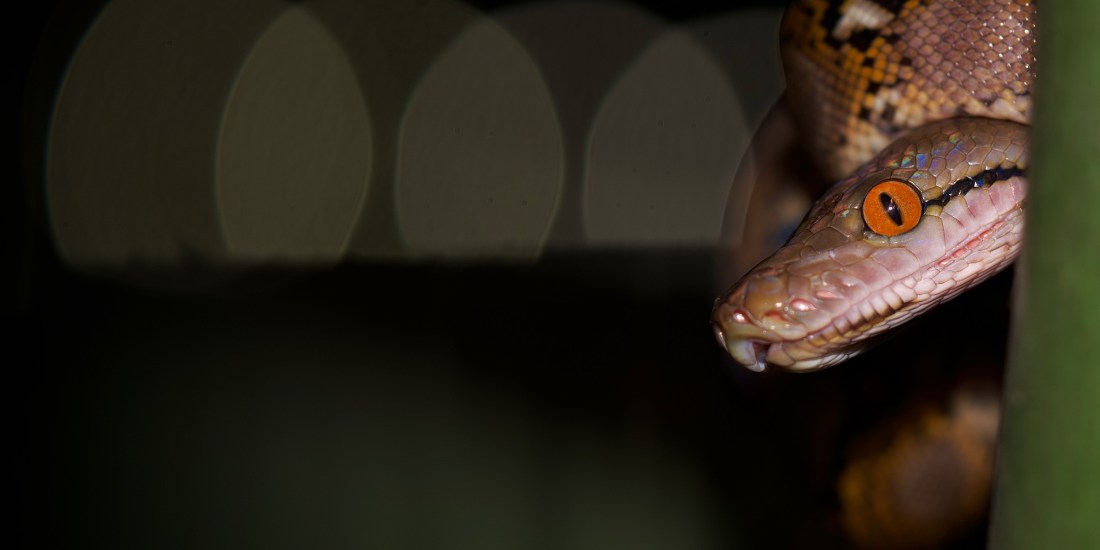
Singapore is a city-state with a high population density and low land availability. Somehow, biodiversity endures. But in this risk-averse society the few remaining top predators are pushed to the margins, mainly inhabiting the coastal mangroves. One of the few remaining predators has struck fear into humans for time immemorial. The longest snake on planet earth – the Reticulated python.
The Reticulated python is the stuff of legends. For people like me, it is a bucket-list wildlife encounter. A dream come true. For many others, it is the stuff of nightmares. I set out to try to find the famous reptile and to understand how I would feel in the presence of a “monster”.
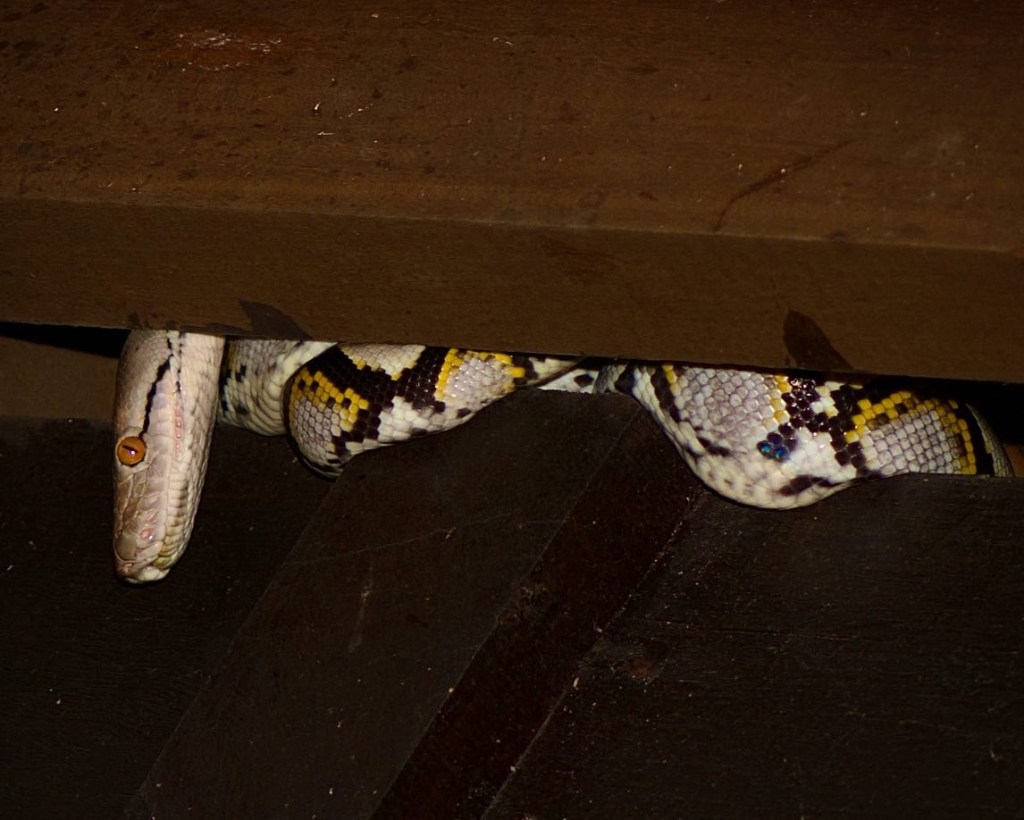
My first encounter was as unexpected as it was thrilling. A visit to the Sungei Buloh mangroves always brings exciting wildlife experiences. It happened just moments after arriving. A reasonable-sized python was coiled in the visitor centre rafters. It didn’t take long to realise the reason that the python was prepared to position itself in such a public place. A roost of Lesser short-nosed fruit bats was hanging like warm, furry python popcorn nearby. An easy meal for a hungry snake.
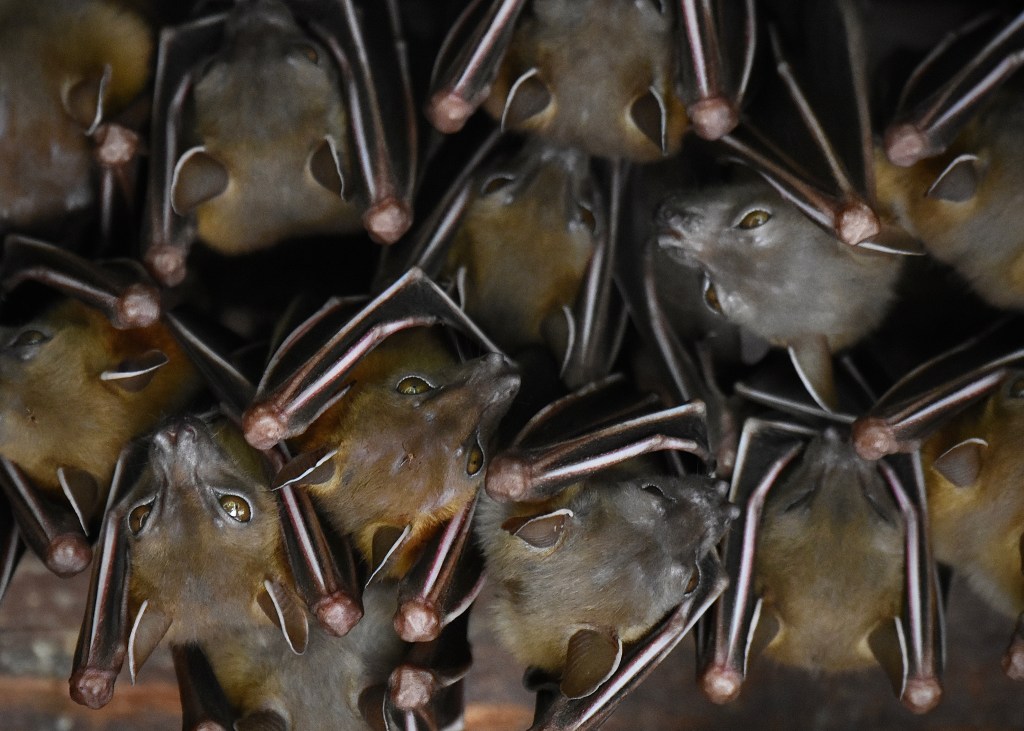
This was my only python sighting for a long time, despite endless late nights of walking until my feet were sore. It was thrilling to see the snake, but it was also high in the rafters, meaning the encounter didn’t feel intimate. There were too many visitors arriving who I was sharing the experience with, which made it feel more like a zoo than a wild encounter. The python was definitely one to tick off of the checklist, but I needed a better experience.
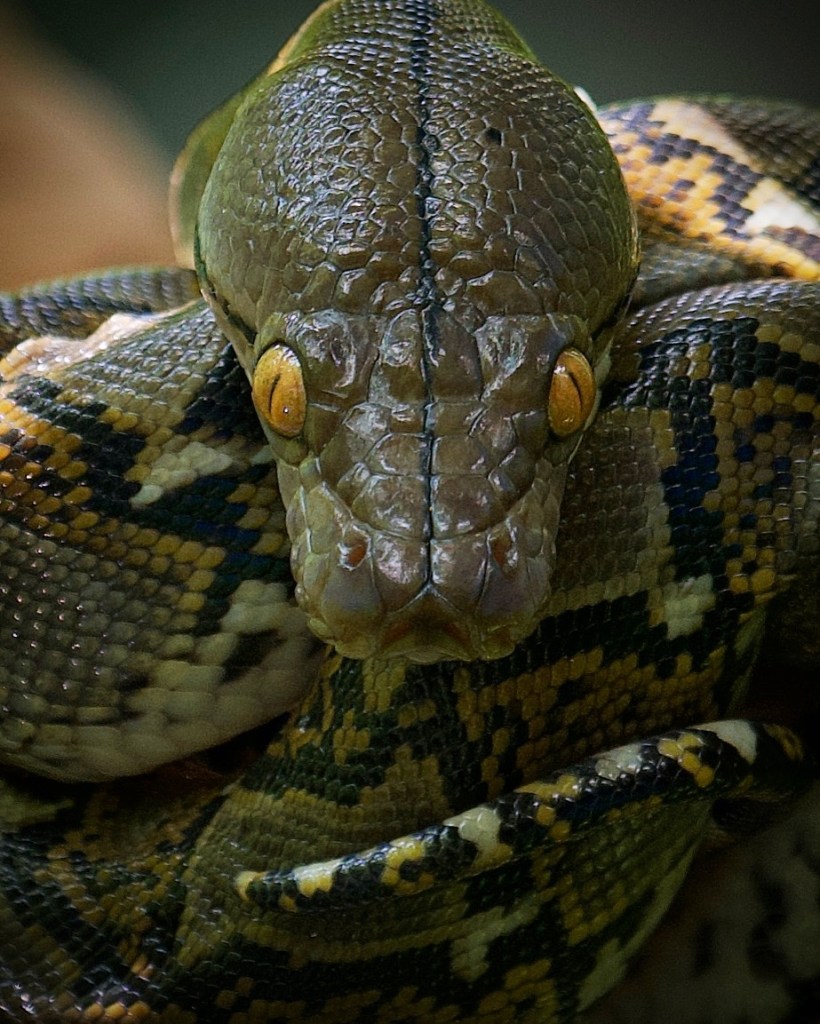
Several months passed before my next encounters. I found three individuals in quick succession. These snakes were just a few minutes’ walk from my home. I don’t know how it caught my eye, but I was walking along the footpath of a very busy main road when I spotted a dark shape near my foot, to the side of the path. It was just the head of a python poking out of the long grass at the verge. I took a couple of snaps and watched walkers and cyclists passing by, just an arm’s length from a python, while completely oblivious to its presence.
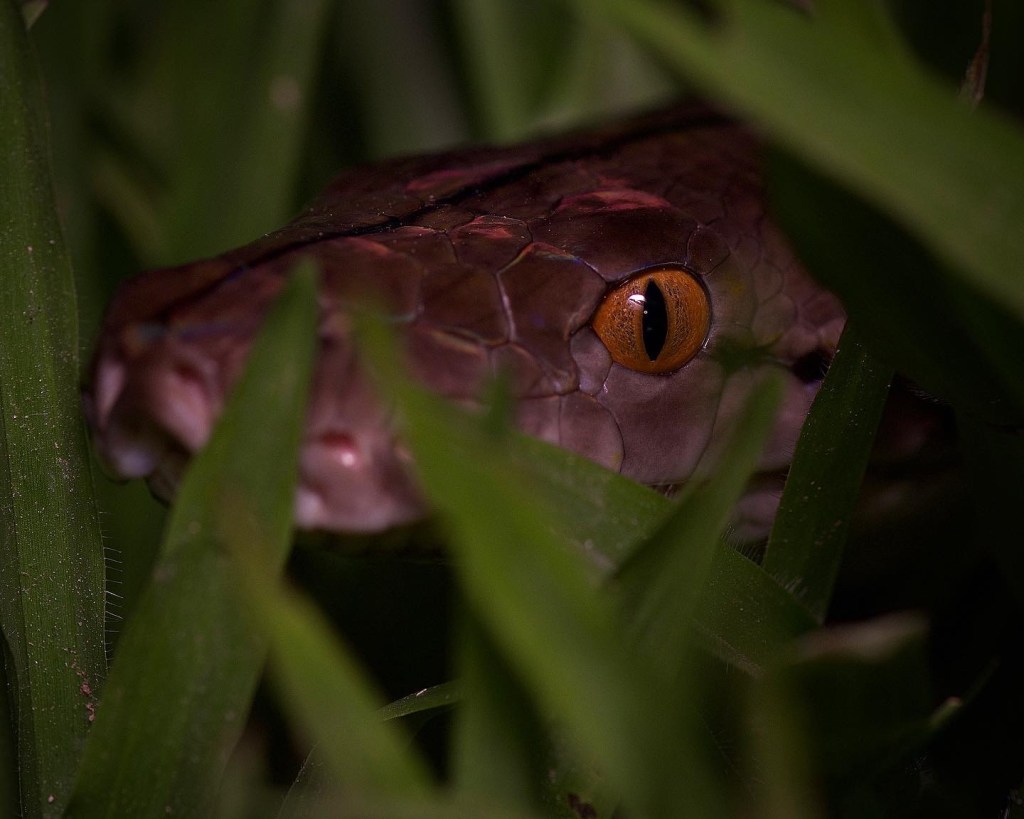
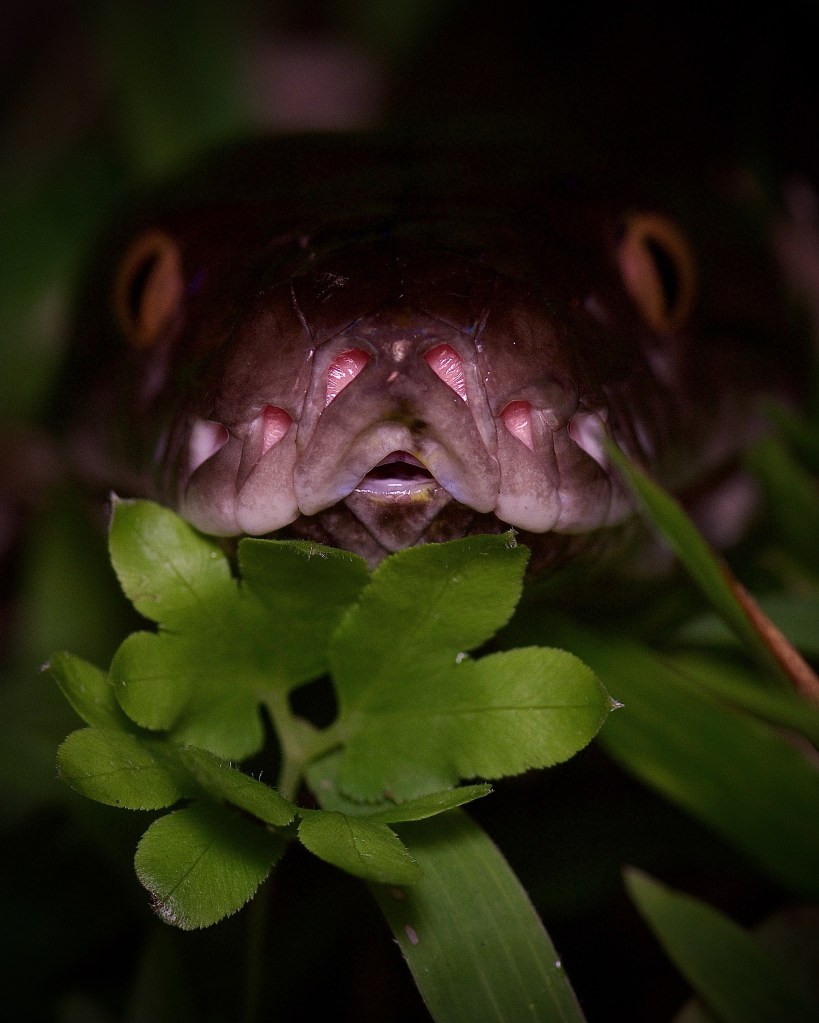
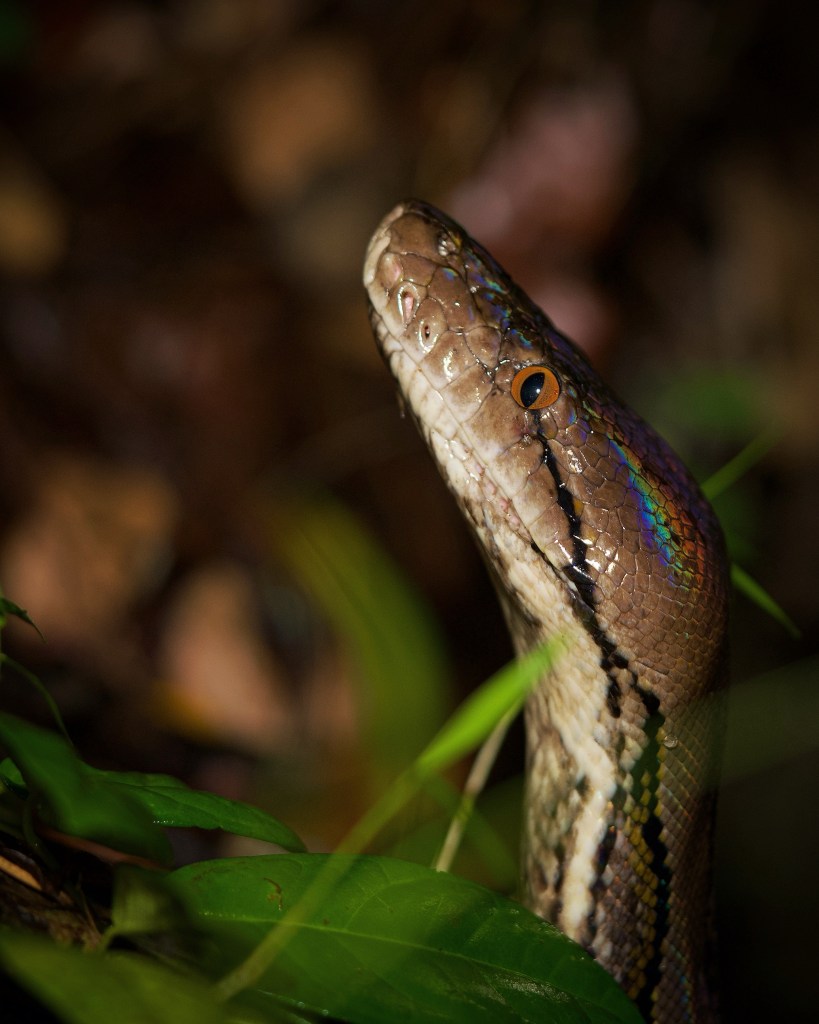
When the coast was clear, I knelt down in front of the python. It didn’t appear too troubled by my presence. I looked into its gum-ball eyes and wondered what it saw when it looked back at me. Pythons do not have good eyesight. What’s the point of good eyesight when you do your hunting at night? To be a night hunter, you need an advantage, and for the python, its advantage is heat-sensing technology called labial pits. The pits were pointing right at me, and I imagined the python seeing a shimmering infrared image of me crouched in front of him.
For a snake to reach the size that an adult Reticulated python does, it needs plenty of food, adequate hiding places, and safe ways to travel without meeting humans or traffic. Singapore experiences two monsoon seasons. When it rains, it really rains, so a network of drainage canals has been created to catch the rainwater before it becomes floodwater and redirect it to the reservoirs. The network of canals are super highways for pythons. The large snakes are able to navigate the city via the canals without risking car tires and aggressive humans. Additionally, the pythons save energy by letting the water hold their body weight.

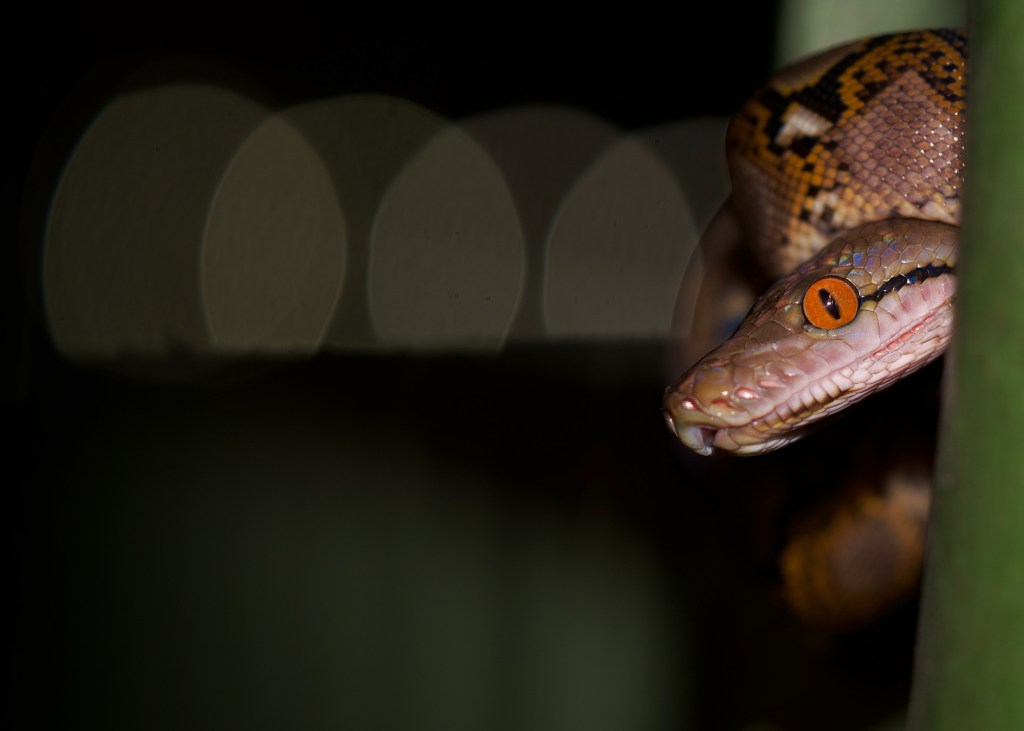
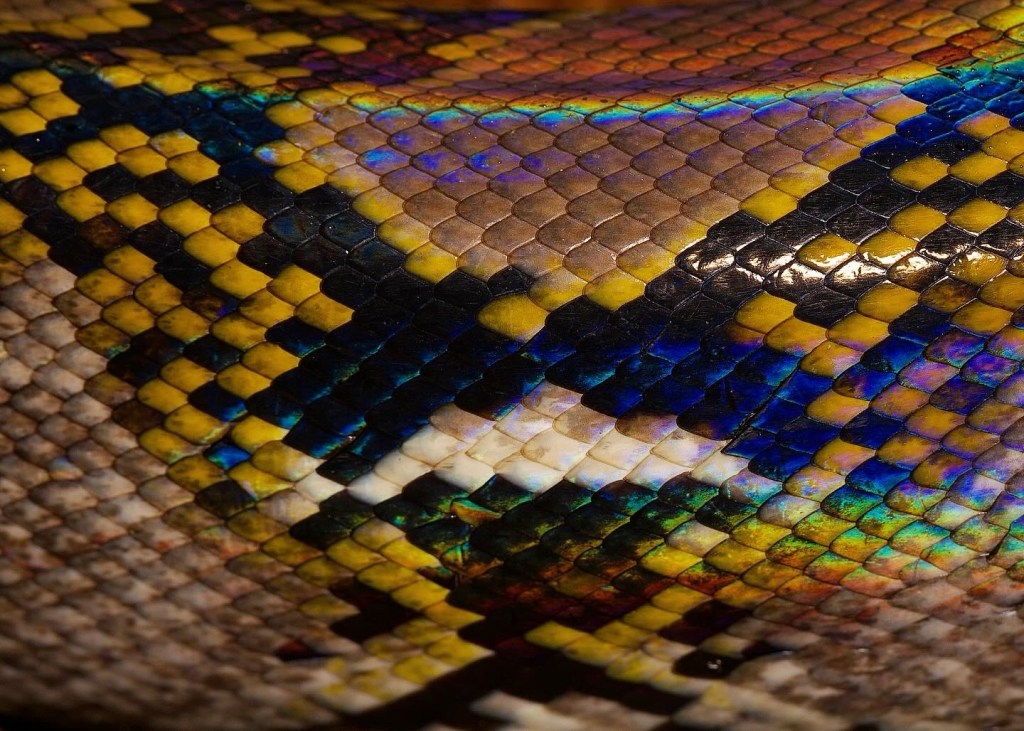
The Reticulated python gets its name from its scale pattern, “reticulated” meaning to have a criss-cross or mesh arrangement. The stunningly beautiful skin provides remarkable camouflage against the forest floor until torchlight sends rainbows scattering across the scales. Unfortunately, human vanity costs the Reticulated python dearly, with over 300,000 skins being harvested legally each year from wild snakes in Malaysia and Indonesia. The actual number is no doubt much higher with a booming black market trade in wildlife body parts.
Personally, I think the python wears its gorgeous skin much better than humans do.
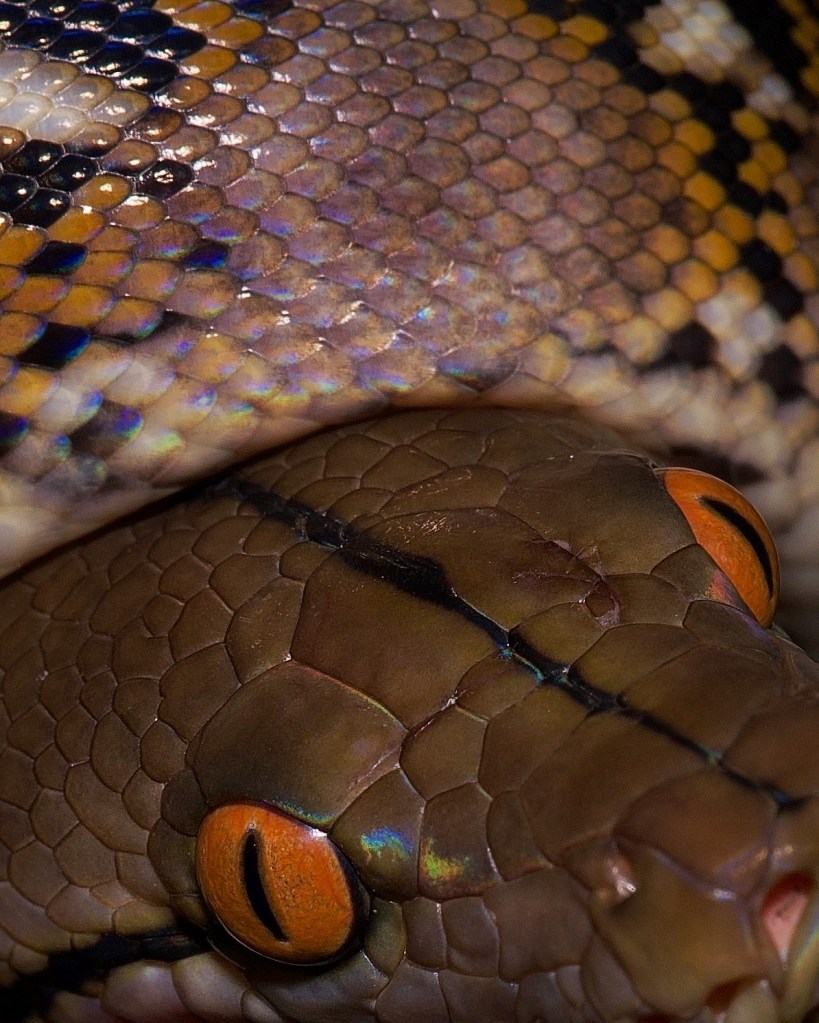
Having now had several python encounters, perhaps I had started to normalise meeting these huge reptiles of suburban nights. I had not found anything bigger than about 2 metres long. I had taken some photos, but mainly only close-ups of a snake head poking out of the grass. Then it happened. It was a Friday night, and I was walking past a station in a busy area. There was a small drainage stream that passed under the road. Whenever I passed the stream, I would use a small torch to check for snakes but never saw anything.
This night was different. I shone my torch down the stream and saw something small that seemed to be moving across the surface of the shallow water. It was moving side to side. I started to think that it was a frog doing something unusual. I leaned against the railing and squinted. As it came towards me, I realised that I was looking at the tip of a snake’s snout.
I ran to a spot where I could get around the railings to the edge of the stream. My eyes widened, and my heart started thumping out of my chest. A huge Reticulated python was winding its way along the stream. I scrambled down the bank, sinking into the soft mud. There was nothing I could do with my camera to show off this spectacular specimen, so I used my phone to try to capture the size and sheer presence of the magnificent snake. It paid no attention to me, even when I stood astride it as it made its way up the bank to the long grass.
To my amazement, it slithered into the small patch of long grass and entirely disappeared from view. It seemed extraordinary that I had just witnessed a massive snake at a busy commuter station, and not another soul had noticed the prodigious python or the crazy human filming it.
I walked back home straight away. There was no point in carrying on with a walk. I was still shaking, and my heart and mind were racing. This was the python experience that I had imagined. This was very much a wild and intimate python experience.
The Fear of Monsters
So the question we must ask is, is the fear of the Reticulated python justified? Well, yes and no. Let’s explore.
A large Retic is a dangerous creature, no doubt, but context is everything. In some parts of Southeast Asia, large snakes continue to grow and become enormous. Most of the enormous specimens that have been found have become the stuff of legends, because they have not been formally measured and witnessed due to the remote villages where they are encountered. In 2025 a new Guinness record was verified on the Indonesian island of Sulawesi. A snake called Ibu Baron (The Baroness) was measured at 7.21 meters (23 feet and 8 inches long), weighing in at 96.6 kilograms (213 pounds). Unusually, she was captured alive and survives in a rescue facility. Sulawesi is the home of most of the real giants, and we have to acknowledge that these giants have killed and eaten humans.
Sulawesi has a particular set of conditions that create this human/python conflict. Humans are moving further into the forests to farm plantations, and for evolutionary reasons, Sulawesi has a gap in mid-size prey availability, meaning the python has to fast-forward from eating rats to catching prey as big as wild pigs. To a massive snake sat alongside a forest trail at night, a small human and a large pig represent the same thing: a dinner.
The Singapore Reality
Giant pythons were once found in Singapore, but not since 1908, when a 6.7-meter (21 feet 11 inches) individual was recorded. In modern Singapore, on a diet primarily made up of small rats, most Retics that are found measure between 2 and 4 meters. A snake of this size poses no threat to humans, beyond a potentially painful bite for those foolish enough to disturb a cornered snake. Indeed, they are a vital support to us in our efforts to control the ever-expanding rat population.
I have now found many pythons in Singapore and been very close to them without seeing even a hint of aggressive behaviour. The largest python that I have encountered (shown in the videos above) was probably the longest snake that I have heard of from my Singapore snake enthusiast network. This was a pristine python of around 5 meters, but it was a relaxed snake, no doubt hunting the urban stream for rats.
The Hunt
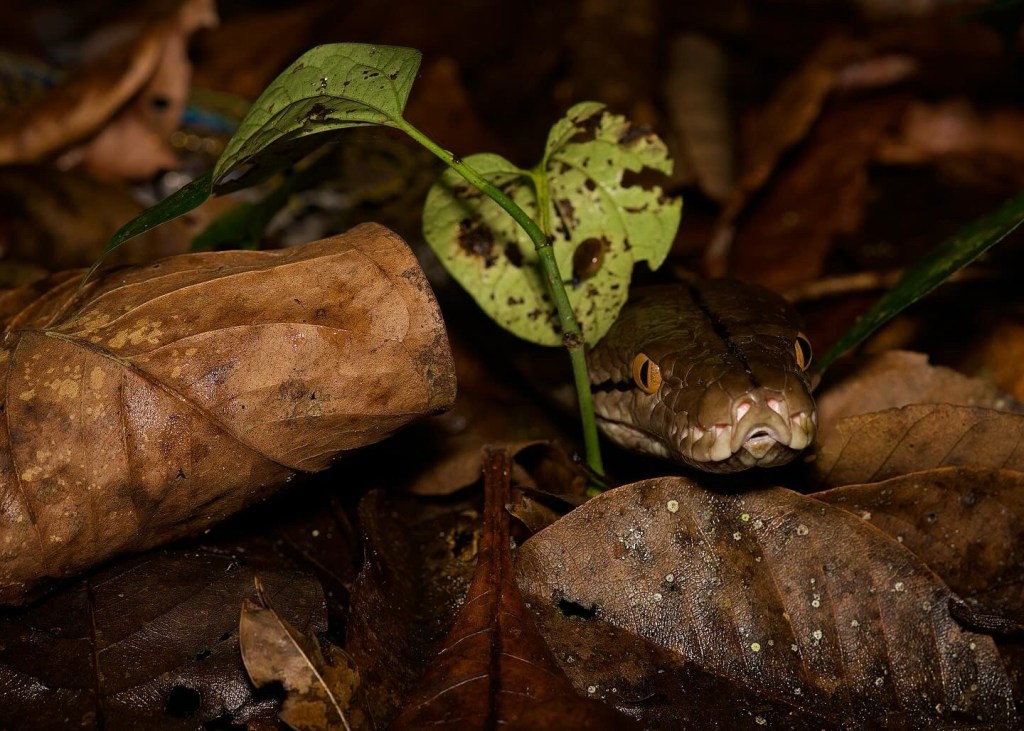
My torchlight scanned a drain close to a dumpster where I had frequently seen rats. I had checked the drain many times before because I felt that there was always a rodent buffet awaiting a hungry snake. Finally, today my torchlight sent rainbows shimmering along python scales. I had arrived on the scene just in time, as a large python, maybe 3 meters long, was in the process of constricting a rat.
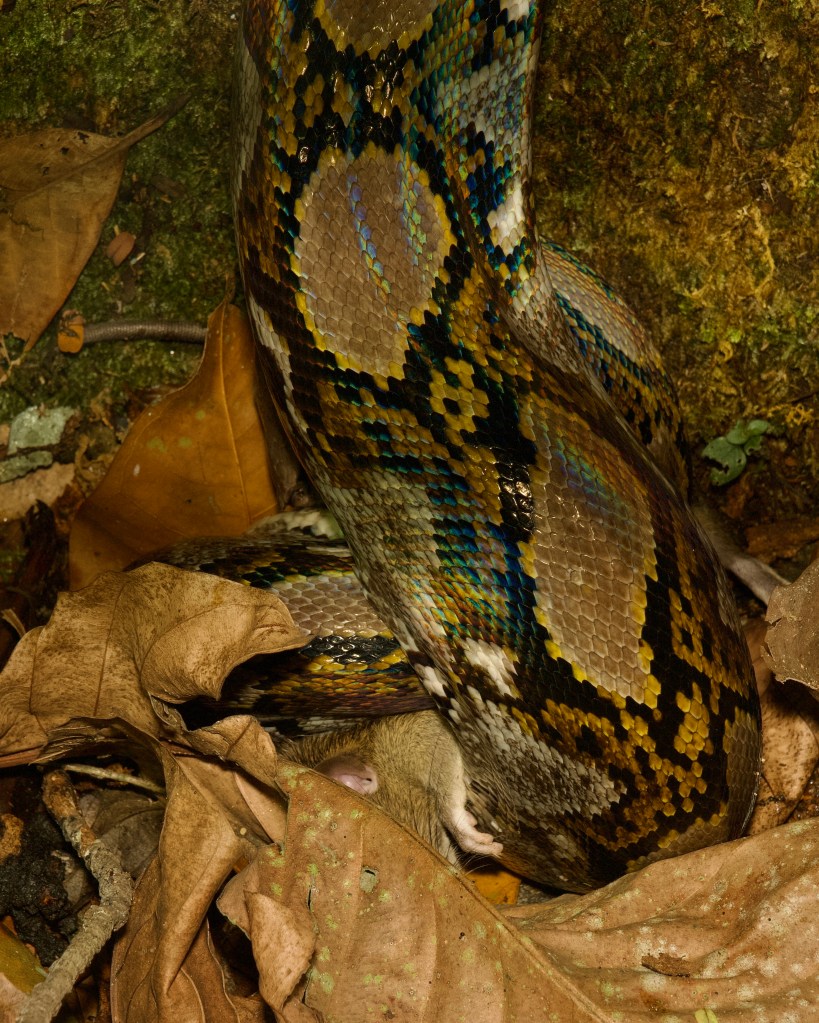
There is a common misconception, perhaps thanks to a history of shows such as Tarzan, that pythons kill by crushing and suffocating their prey. In fact their method of killing is much more sophisticated.
The python first strikes its prey, grabbing it with its mouth. Sharp, backward-facing teeth ensure a good hold. The initial hold is followed by a rapid coiling around the victim. This is where things get interesting. Carefully targeted constriction stops the victim’s blood flow, preventing oxygen from reaching the heart and brain. The lack of oxygen leads to rapid unconsciousness. The victim’s heart is unable to pump against the blood pressure created by the constriction, resulting in cardiac arrest and death. The python monitors the prey’s heartbeat so that it knows when the job is complete.
Having killed its prey, the python needs to eat it. Another common misconception is that the snake dislocates its jaw to eat a large meal. In reality, the bottom jaw is made of two separate parts that are connected with an elastic ligament. The two sides of the jaw work independently to almost walk the prey into their mouth, while a glottis, or breathing tube, moves to the side to prevent suffocation.
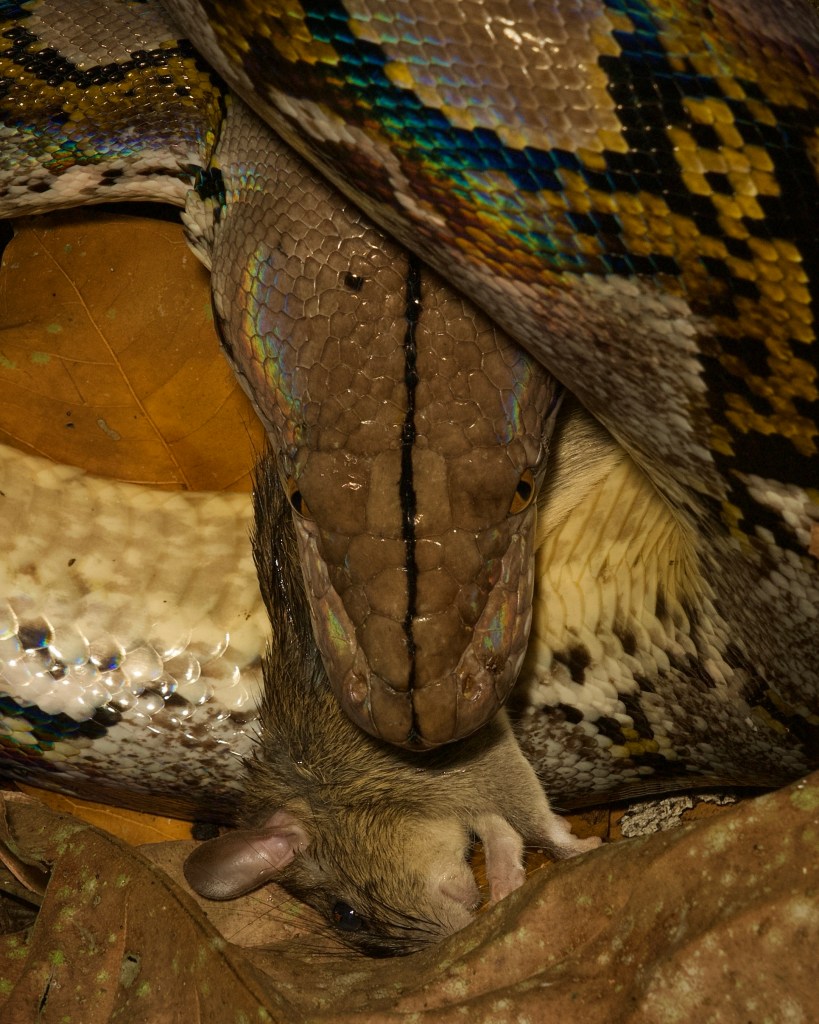
I watched the python devour its ratty snack. Having swallowed the rat, I assumed that the snake would slither into the forest to digest its meal, but this was not the case. The python repositioned itself back on the edge of the drain with its head pointing down in a strike position to wait for another unsuspecting rat to pass by. This was a snake performing a great pest control service.
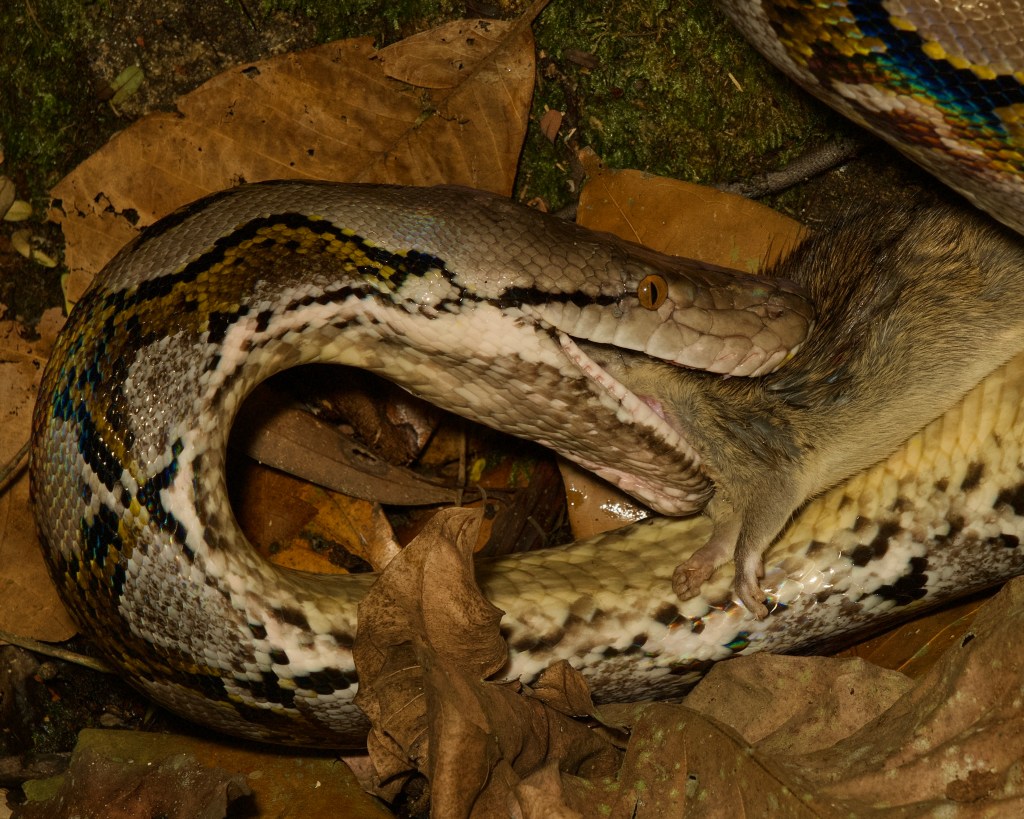
Along with its arch nemesis, the King cobra, the Reticulated python is by far the most engaging and spectacular reptile in South-east Asia. At least, it is for me. Every night that I go out, it is my main snake target. For something so large and allegedly so common, pythons are difficult to find. But every encounter is a joy, and I always want the next encounter to come quickly.
I started this story by wanting to understand how I would feel in the presence of a monster. The truth is that I was a little nervy for my first very close encounters. Those nerves came from inside me, not from the snake in front of me.
Now I don’t see a monster at all. I see a beautifully marked creature that avoids humans at every opportunity and never comes forward when it can go backwards. The Reticulated python is a triumph of evolution that has learned how to survive and thrive in our concrete jungles, navigating the drains and waterways, mopping up disease-carrying vermin as it goes.
I’m sure that I’ll be out again tonight searching the edges of city-state suburbia for the planet’s longest reptile.
Thank you for making the time to read this article. I hope you enjoyed it. If you did, please consider sharing it on social media, or recommend it to a friend. It makes the effort worthwhile.
For more wild content follow Incidental Naturalist. If you don’t have a WordPress account you can follow via email.


Thanks for the education and amazing photos. Their colors are amazing.
LikeLiked by 1 person
Thank you for the kind words. Very much appreciated! It’s amazing how the beautiful colours light up with rainbows under flashlight.
LikeLike